How Fast Can an Ostrich Run in km/h, vs cheetah speed & more
How fast can an ostrich run: An ostrich can run at speeds of up to about 70 kilometres per hour (43 miles per hour) in a short sprint, and can keep up a steady pace of roughly 50 kilometres per hour (about 30 miles per hour) over long distances, which makes it the fastest bird on land and the fastest two-legged runner of any animal.
Two features explain that speed: very long legs that cover three to five metres in a single stride, and feet with just two toes, which reduces weight and helps the bird push off the ground efficiently.
Humans cannot compete: even the fastest sprinters in the world peak at around 44 kilometres per hour, well below an ostrich’s top speed.
This guide explains exactly how fast an ostrich can run, how it compares with cheetahs, lions and people, how the ostrich’s body is built for speed, why ostriches run, and where in East Africa you can watch ostriches in full flight.
How Fast Can an Ostrich Run? Speed at a Glance
| Measure | Ostrich Running Speed |
|---|---|
| Top sprint speed | About 70 km/h (43 mph), in short bursts |
| Sustained running speed | Roughly 50 km/h (about 30 mph) over long distances |
| Stride length at speed | About 3 to 5 metres (10 to 16 feet) |
| Toes per foot | Two |
| Title | Fastest bird on land and fastest bipedal land animal |
Figures are rounded and vary by individual, age and terrain. Some websites claim ostriches reach 60 mph, but the best-supported top speed is about 70 km/h (43 mph).
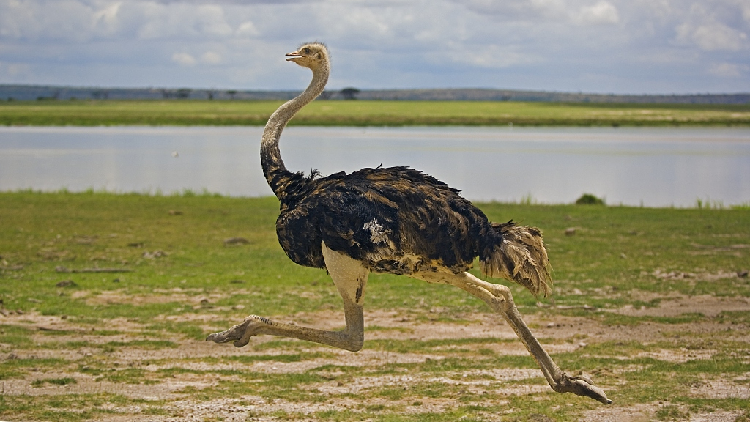
Ostrich Top Speed: Sprinting at 70 km/h (43 mph)
When an ostrich is threatened and needs to get away, it can accelerate to about 70 km/h (43 mph), a speed that no other bird can match on the ground.
That top speed lasts only for short bursts, the way a sprinter’s does, and is reached on firm, open ground. On soft sand, rough terrain or dense scrub, an ostrich is slower, which is one more reason ostriches live on open savanna and semi-arid plains (see our guide to where ostriches live).
Ostrich Sustained Speed: Built for Endurance
What sets the ostrich apart from many sprinters is stamina. Instead of tiring after a few seconds, an ostrich can hold a steady running speed of around 50 km/h (about 30 mph) for a long distance, and some sources say it can keep this up for a good half hour.
That endurance matters because a predator that chases an ostrich cannot simply rely on a short burst of speed. In practice, an ostrich often wins the race by wearing its pursuer out.
How Does an Ostrich Compare With Other Animals?
| Animal | Approximate Top Speed |
|---|---|
| Ostrich | About 70 km/h (43 mph) |
| Fast human sprinter | About 44 km/h (27 mph) at peak |
| Emu | About 48 km/h (30 mph) |
| Lion | About 80 km/h (50 mph) in short bursts |
| Cheetah | About 100 km/h (60 mph or more) in short bursts |
Speeds for other animals are commonly cited, rounded figures.
Ostrich vs. human: An ostrich is far faster than any person. Even the fastest recorded human sprint speeds are well below an ostrich’s top speed, and over longer distances an ostrich’s steady pace is still faster than most people can sustain.
ostrich vs cheetah speed: A cheetah is faster than an ostrich over a short sprint, so in a straight dash the cheetah wins. But cheetahs can only sustain their top speed for a short time, whereas an ostrich can keep running at a fast pace for much longer, which is part of why ostriches are not an easy meal for a cheetah.
Ostrich vs. lion: Lions can match or exceed an ostrich’s speed for a few seconds, but they tire quickly and usually rely on ambush, which is hard to pull off against a bird with excellent eyesight in open country.
How fast can an ostrich run with a rider: An ostrich can run at speeds of up to 70 km/h (43 mph) without a rider, but carrying a rider significantly reduces its speed and endurance. Ostrich riding is also uncommon and can be dangerous for the bird and rider. There is no reliable standard maximum speed for a ridden ostrich.
Why Are Ostriches So Fast? How the Body Is Built for Running
An ostrich’s speed comes from its anatomy:
- Very long legs. The ostrich has the longest lower leg bone (tarsus) of any living bird, which helps give it a huge stride of about three to five metres.
- Only two toes. Most birds have four toes on each foot, but the ostrich has just two, with a hoof-like nail on the larger inner toe. Fewer toes means less weight at the end of the leg and a more efficient push-off, similar to how a horse’s hoof works.
- Springy tendons. Elastic tendons in the lower legs store and return energy with each stride, which saves effort and supports endurance.
- Strong, lightweight build. Powerful leg muscles are concentrated high on the leg, so the lower leg stays light and swings quickly.
- Wings for balance. Although ostriches cannot fly, they hold their wings out while running, and the wings act as stabilisers that help them steer and turn sharply at speed.
- Excellent eyesight. Large eyes and a tall head let ostriches spot danger early, so they often begin running before a predator gets close.
Why Do Ostriches Run?
Ostriches run mainly to escape predators. In the savanna they face lions, cheetahs, leopards and hyenas, and speed is their main defence. A frightened ostrich may also zigzag, which makes it harder to catch, or flatten itself against the ground to hide, depending on how close the threat is. Ostriches also run when they are on the move to find food and water, covering large distances across open country.
And running is not the ostrich’s only weapon. If cornered, an ostrich can deliver a powerful forward kick with its large clawed foot, which can seriously injure or even kill a predator, and is dangerous to people too. That is why you should always keep a safe distance from ostriches on safari.
Can You Outrun an Ostrich?
No. A person cannot outrun an ostrich over any realistic distance, because an ostrich’s top speed is far above that of any human sprinter, and its steady running pace is faster than most people could keep up for long.
If you meet a wild ostrich on a safari, never approach it or run at it. Stay in your vehicle, follow your guide’s advice, and enjoy the sight from a safe distance.
How Fast Can Baby Ostriches Run?
Ostrich chicks are mobile almost from the start. Within days of hatching, they can follow their parents and run to keep up with the group, though they are far slower than adults and depend on the adults for protection.
They gain speed as they grow, reaching adult running ability only after they are fully developed. For what the young birds eat as they grow, see our guide to what ostriches eat.
Tips for watching ostriches run.
- Choose open plains. Ostriches run most readily across wide, firm ground.
- Go early or late. Ostriches are more active in the cool hours, and the light is excellent for photography.
- Use a fast shutter speed if you want to freeze a running ostrich in a photo.
- Keep your distance. Ostriches can be unpredictable and a kick is dangerous.
- Be patient. You may not see a full sprint, since ostriches usually run only when startled, but you will often see them walk, trot and display.
Frequently Asked Questions: How Fast Can an Ostrich Run?
How fast can an ostrich run? Up to about 70 km/h (43 mph) in a short sprint, and roughly 50 km/h (about 30 mph) over long distances.
How fast can an ostrich run in mph? About 43 mph at top speed, and around 30 mph at a sustained pace.
How fast can an ostrich run in km/h? About 70 km/h at top speed, and around 50 km/h sustained.
Is the ostrich the fastest bird? It is the fastest bird on land. Some flying birds are faster in the air, but no bird runs faster than an ostrich.
Can an ostrich outrun a cheetah? Not over a short sprint, since a cheetah is faster. But an ostrich can sustain a fast pace for much longer, which is why cheetahs do not always catch them.
Can a human outrun an ostrich? No. An ostrich’s top speed is far above the fastest human sprint, and its steady pace is faster than most people can hold.
Why can ostriches run so fast? Because of their long legs, which give a stride of three to five metres, their two-toed feet, springy tendons, strong leg muscles and wings that act as stabilisers.
How long can an ostrich keep running? An ostrich can run at a steady, fast pace over long distances, far longer than a cheetah can sprint, although exact times depend on the bird and the terrain.
How far can an ostrich step in one stride? About three to five metres (10 to 16 feet) at speed.
Why do ostriches have only two toes? Fewer toes reduce the weight at the end of each leg and improve push-off, an adaptation that helps ostriches run fast.
Where can I see ostriches run? On the open plains of East Africa, including Kidepo Valley National Park, Maasai Mara, Amboseli, Samburu, Tsavo, the Serengeti, Tarangire and Ngorongoro Crater.
See the World’s Fastest Bird for Yourself, With Us
Reading that an ostrich can reach 70 kilometres per hour is one thing. Watching a six-foot-plus bird thunder across the plains with enormous strides, wings held out for balance and dust rising behind it, is something you will remember long after the trip is over, and East Africa is the best place on Earth to see it.
The best places to see ostriches are Kidepo Valley National Park in Uganda, the Maasai Mara, Amboseli, Samburu and Tsavo in Kenya, and the Serengeti, Tarangire and Ngorongoro Crater in Tanzania.
With Gorilla Nests Safaris, you can see ostriches on the open plains, then trek mountain gorillas in Bwindi and track chimpanzees in Kibale, all on one trip planned around the animals you most want to see.
Browse our Uganda safari packages, read about us, or contact our team today and tell us you want to see ostriches in East Africa. We will plan the route, the lodges and the guides, so all you have to do is watch the world’s fastest bird in action.