Nile Crocodile Size: How Big Do They Really Get?
Nile Crocodile Size: How big is a Nile crocodile? See average length, weight, growth by age, record sizes, and how they compare to other crocodiles — plus where to see one in Uganda.
Nile crocodile size is one of the most searched questions about this apex predator, and for good reason — few animals in Africa’s rivers and lakes command the same sheer physical presence.
This guide focuses specifically on exactly how big Nile crocodiles get, how their size changes from hatchling to fully grown adult, how males and females differ, and how the Nile crocodile stacks up against the world’s other crocodilians in terms of raw scale.
How Big Is a Nile Crocodile on Average?
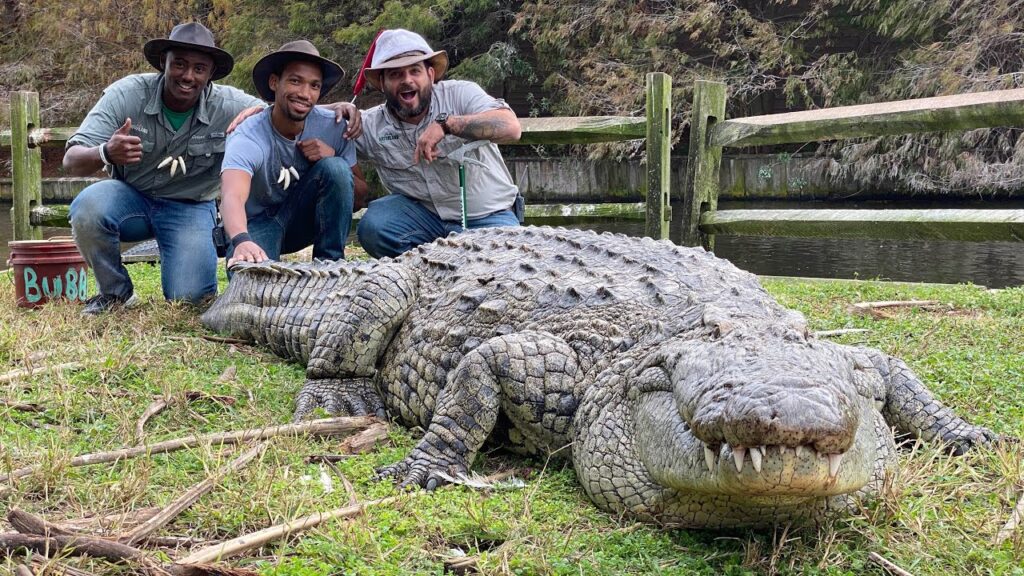
The average Nile crocodile size for a fully grown adult male sits around 5 meters (16 feet) in length — already an imposing figure, and one that places the species firmly among the largest reptiles alive today. Exceptional individuals have been documented reaching up to 6 meters (nearly 20 feet), though truly confirmed specimens at that upper end are genuinely rare.
Females run consistently smaller across the species’ entire range, typically measuring 20–30% shorter than males, with a fully grown adult female averaging closer to 3.5 meters.
This size gap between sexes — known as sexual dimorphism — is a defining feature of Nile crocodile biology, and it means the biggest individual in any given stretch of river is almost always going to be a mature male.
Nile Crocodile Size by Age and Growth Stage
Understanding Nile crocodile size properly means tracking it across the species’ full life cycle, since growth is genuinely dramatic between hatching and full maturity.
Hatchlings emerge from the egg at around 28–30 cm (roughly 11–12 inches) — small enough to comfortably fit in a human hand, and vulnerable to a long list of predators including birds, monitor lizards, and even other crocodiles during this earliest stage.
Juveniles grow relatively quickly during their first several years, often gaining 20–30 cm annually under good conditions, though growth rates vary meaningfully depending on food availability, water temperature, and population density in a given habitat.
Sub-adults, typically between 2–3 meters in length, represent the awkward middle stage — large enough to take genuinely substantial prey, but not yet dominant enough to claim the best territory from established adults.
Full maturity is reached at around 12–15 years of age for males, by which point growth slows considerably, though Nile crocodiles do continue growing, at a much reduced rate, throughout their entire lives — a trait shared with most crocodilians and one reason the very oldest individuals in a population are consistently also the very largest.
How Much Does a Nile Crocodile Weigh?
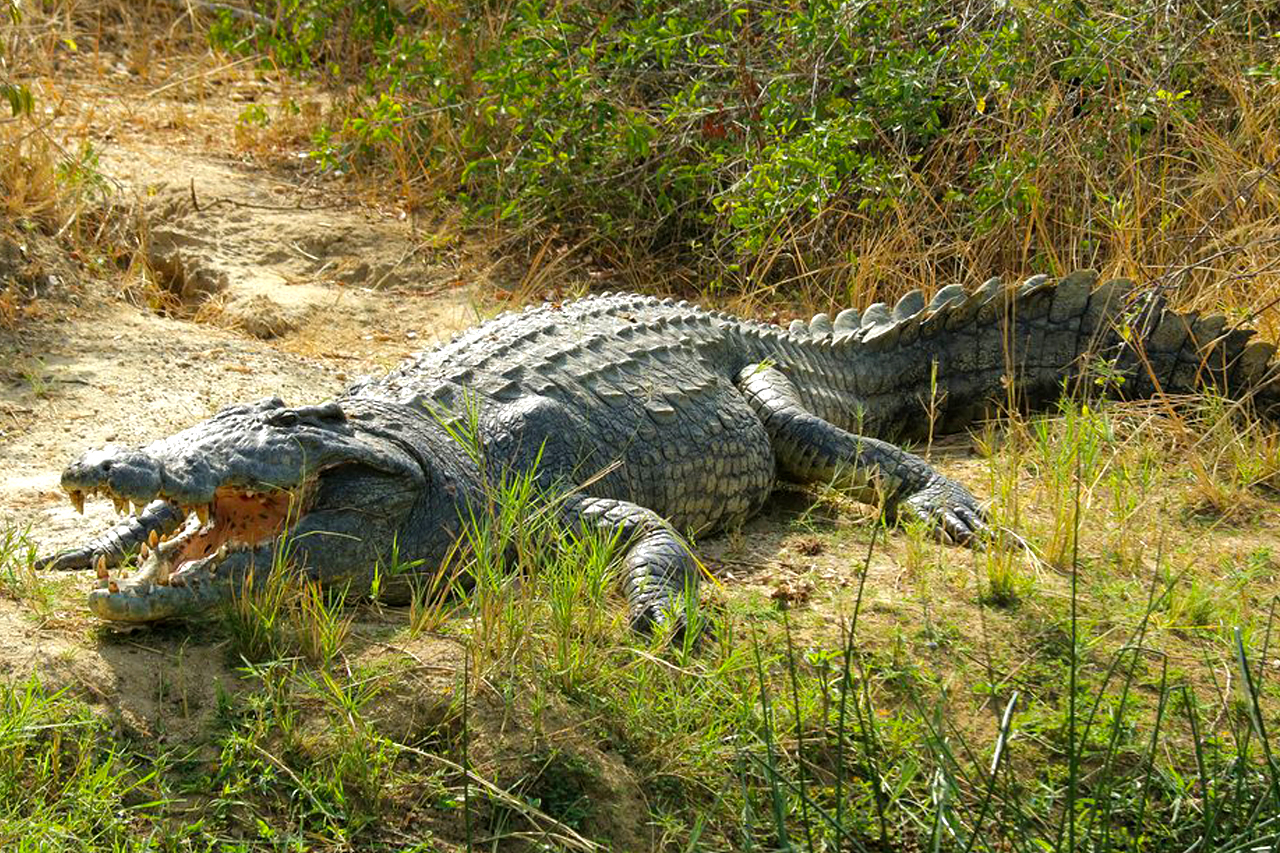
Weight scales dramatically alongside length. A large adult male Nile crocodile typically weighs 400–500 kg (880–1,100 lbs), with the biggest confirmed individuals reaching 900–1,000 kg — genuinely comparable to a small car in mass. Females, consistent with their smaller length, weigh considerably less, generally falling in the 150–300 kg range.
This weight is distributed across a genuinely powerful frame: a heavily muscled tail used for propulsion and as a weapon, a broad, armored body, and jaw muscles capable of generating one of the strongest bite forces of any living animal — all packed into a size profile that makes the Nile crocodile a formidable presence in any stretch of water it inhabits.
Record-Breaking Nile Crocodiles
Occasional reports of exceptionally large individuals circulate widely, the most famous being “Gustave,” a Nile crocodile reputed to inhabit Burundi’s Ruzizi River and Lake Tanganyika shoreline, rumored in popular media to exceed 6 meters and weigh over 900 kg.
It’s worth noting directly that Gustave’s exact dimensions have never been scientifically verified through direct measurement — much of his reputation rests on eyewitness accounts and unconfirmed estimates rather than a confirmed capture and measurement, which is a genuinely common pattern with “record” wild crocodile claims more broadly.
Treat any specific record-breaking size claim for a wild, unmeasured individual with a healthy degree of skepticism, even when the underlying species is genuinely capable of reaching those dimensions.
Scientifically documented, directly measured specimens rarely exceed 6.1 meters, and even individuals in that upper range are exceptionally uncommon across the species’ full population.
Nile Crocodile Size Compared to Other Crocodilians
Understanding where the Nile crocodile sits among the world’s crocodilians puts its size in real context:
Is the Nile crocodile bigger than the Australian crocodile? Saltwater crocodile — the world’s largest living reptile, regularly exceeding the Nile crocodile in both length and weight, with confirmed individuals surpassing 6 meters and 1,000+ kg. The Nile crocodile is consistently ranked second overall.
American alligator — noticeably smaller, with adult males typically reaching 3.4–4.4 meters, making the Nile crocodile meaningfully larger on average.
American crocodile — closer in size to the Nile crocodile but still generally smaller on average, with adult males typically topping out around 4–5 meters in most populations.
Gharial — genuinely comparable in overall length in some populations, though built with a dramatically different, narrow snout adapted for fish-catching rather than the broader, generalist jaw of the Nile crocodile.
This comparison makes clear why the Nile crocodile’s size matters so much to its ecological role — it’s large enough to sit at the very top of its food web, with no natural predator once it reaches adulthood, aside from other large Nile crocodiles.
Nile crocodile size compared to a human” — an average adult male Nile crocodile (~5m) is roughly 3 times the height of an average adult human lying down head-to-toe, and at 400–500 kg, outweighs an average human by 5–7 times. A crocodile’s head alone can be nearly as long as a human forearm.
How big was the biggest Nile crocodile? —The biggest reliably documented Nile crocodiles have reached around 6 metres (20 feet) or more in length and weighed close to 1,000 kilograms. Legends describe larger individuals, but many extraordinary size claims remain difficult to verify scientifically.
Does Nile Crocodile Size Vary by Region?
Real variation in Nile crocodile size exists across different populations and habitats. Crocodiles in nutrient-rich, prey-abundant waters — including major river systems and large lakes — tend to reach larger average sizes than populations in smaller, more marginal habitats with less consistent food availability.
Water temperature also plays a genuine role, since crocodiles are ectothermic and their growth rate is directly tied to ambient conditions throughout the year.
Populations in East Africa’s major rivers and lakes, including those found across Uganda and along the Nile itself, are consistently among the larger, healthier populations studied, reflecting the rich prey base and extensive habitat available in this part of the continent.
Why Nile Crocodile Size Matters for Safety and Viewing
Understanding real Nile crocodile size isn’t just academic — it directly shapes how guided wildlife viewing works in practice.
Larger, older individuals tend to hold the prime basking spots and territory along riverbanks and channel edges, which is exactly why experienced guides can often predict where the biggest crocodiles in a given stretch of water are likely to be found.
This knowledge is central to genuinely good boat-based wildlife viewing on safari, where getting a clear, safe view of a large adult crocodile is one of the most memorable moments of an East Africa itinerary.
See Full-Grown Nile Crocodiles on a Uganda or Rwanda Safari
Reading about hatchling-to-adult growth curves is one thing — watching a genuinely large adult Nile crocodile slide off a sandbank into the water is something else entirely, and it’s a highlight built into several of our East Africa itineraries.
Uganda Safaris With Strong Crocodile Viewing
Our 3 Days Murchison Falls Safari includes the Victoria Nile boat cruise, Uganda’s single best opportunity to see genuinely large adult Nile crocodiles basking along the riverbank — our Murchison Falls facts guide covers the park in more depth, and our Murchison Falls accommodation guide covers where to stay nearby. Our 3 Days Queen Elizabeth National Park Safari features the Kazinga Channel, another exceptional crocodile viewing location, alongside the park’s famous tree-climbing lions and safari lodges for every budget. Our 3 Days Lake Mburo Safari offers a smaller-scale but genuinely reliable alternative.
Combine Crocodiles With Primate Trekking
Our 3 Days Kibale National Park Safari and Bigodi Wetland Sanctuary cover Uganda’s chimpanzee side, while our 4 Days Uganda Gorilla Safari, 3 Days Gorilla Habituation Experience, and 5 Days Uganda Gorilla and Batwa Pygmies Tour cover Bwindi’s mountain gorillas in depth.
Rwanda Safaris and Cross-Border Options
For Rwanda specifically, our Volcanoes National Park Rwanda guide and things to do in Volcanoes National Park page cover gorilla trekking in full, alongside our gorilla permits in Rwanda and broader Rwanda primates safari guides. Add genuine historical context with a visit to the Kigali Genocide Memorial and our guide to the 1994 Rwanda genocide.
Travelers wanting both countries in one trip should browse our 7 Days Rwanda Uganda Safari, 12 Days Rwanda Uganda Gorilla & Wildlife Safari, or our comprehensive 12 Day East Africa Combined Safari. Our best Rwanda safari packages and full Safari Combos collection cover every itinerary length and combination we offer, and our Uganda safari packages page rounds out the full Uganda-only lineup.
Book Your Uganda or Rwanda Safari and See Nile Crocodiles Up Close
Now that you know exactly what makes an adult Nile crocodile so genuinely large — the growth curve, the weight, the record-holding individuals, and how it compares to every other crocodilian on Earth — there’s really only one way to appreciate that scale fully: seeing one for yourself, from a safe, well-guided boat cruise on the Victoria Nile or the Kazinga Channel.
Browse our full range of safari combos or contact us today to build a Uganda or Rwanda itinerary that puts you face-to-face with one of Africa’s largest living reptiles.
Related Pages
- 3 Days Murchison Falls Safari
- Murchison Falls Facts
- Murchison Falls National Park Accommodation
- 3 Days Queen Elizabeth National Park Safari
- Kazinga Channel
- Tree-Climbing Lions Uganda
- Safari Lodges in Queen Elizabeth National Park
- 3 Days Lake Mburo Safari
- 3 Days Kibale National Park Safari
- Bigodi Wetland Sanctuary
- 4 Days Uganda Gorilla Safari
- 3 Days Gorilla Habituation Experience
- 5 Days Uganda Gorilla and Batwa Pygmies Tour
- Volcanoes National Park Rwanda
- Things to Do in Volcanoes National Park
- Gorilla Permits in Rwanda
- Rwanda Primates Safari
- Kigali Genocide Memorial
- 1994 Rwanda Genocide
- 7 Days Rwanda Uganda Safari
- 12 Days Rwanda Uganda Gorilla & Wildlife Safari
- 12 Day East Africa Combined Safari
- Best Rwanda Safari Packages
- Safari Combos
- Uganda Safari Packages
- Contact Us