
Primates of Uganda: Gorillas, Chimps and Monkeys
Primates of Uganda: Uganda is one of Africa’s most rewarding destinations for primate watching, with around 20 recorded primate species living in its tropical rainforests, bamboo forests, woodland and savannah habitats. The primates of Uganda include mountain gorillas, chimpanzees, golden monkeys, red colobus monkeys, black-and-white colobus monkeys, blue monkeys, olive baboons, mangabeys, bushbabies and pottos.
These animals make Uganda an outstanding destination for primate safaris. Visitors can track mountain gorillas in Bwindi Impenetrable National Park and Mgahinga Gorilla National Park, observe chimpanzees in Kibale Forest National Park, and encounter several monkey species during guided forest walks and wildlife excursions.
Whether you are interested in seeing great apes in their natural habitats, photographing colourful monkeys or learning about nocturnal primates, Uganda offers a remarkable variety of experiences.
The Different Types of Primates Found in Uganda
Uganda’s primates can be grouped into three broad categories: great apes, monkeys and smaller nocturnal primates. Their appearances, behaviour, habitats and conservation needs differ considerably.
1. Mountain Gorilla
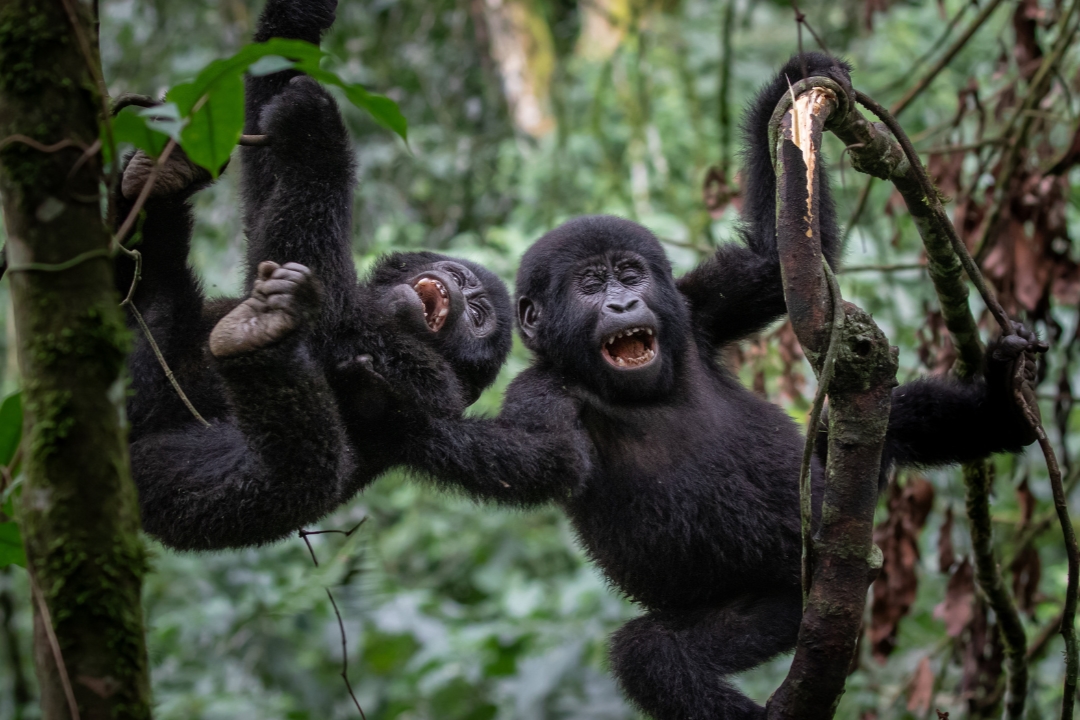
The mountain gorilla (Gorilla beringei beringei) is one of Uganda’s most celebrated primates and a major attraction for international wildlife travellers. These large, intelligent apes live in high-altitude forests and are known for their social family groups, which are usually led by a dominant silverback male.
Uganda protects mountain gorillas in two national parks:
- Bwindi Impenetrable National Park: The country’s main gorilla trekking destination, with four trekking sectors: Buhoma, Ruhija, Rushaga and Nkuringo.
- Mgahinga Gorilla National Park: Part of the Virunga volcanic landscape, offering mountain gorilla trekking through forest and bamboo habitats.
Gorilla trekking involves hiking with trained rangers and trackers to locate a habituated gorilla family. Once the group is found, visitors on a standard trek are allowed one hour to observe the gorillas.
Mountain gorillas are endangered, and responsible tourism contributes to conservation through permit revenue, employment and support for communities around protected areas.
Explore our Uganda gorilla trekking safaris to plan a visit.
2. Chimpanzee
The eastern chimpanzee (Pan troglodytes schweinfurthii) is another remarkable great ape found in Uganda. Chimpanzees live in complex social communities and are known for their intelligence, communication, tool use and close family relationships.
Uganda has several chimpanzee habitats, including:
- Kibale Forest National Park: A leading destination for chimpanzee tracking, with a high concentration of primates.
- Budongo Forest: Located within the wider Murchison Falls conservation landscape.
- Kyambura Gorge: A forested gorge in Queen Elizabeth National Park where visitors can track habituated chimpanzees.
- Kalinzu Forest: Another destination offering guided chimpanzee tracking.
- Semliki and other forest habitats: Important areas for chimpanzees and other forest wildlife.
Chimpanzee tracking takes visitors into the forest with trained guides who follow signs such as calls, feeding remains and movement through the canopy. The experience provides an opportunity to observe the animals feeding, grooming, communicating and moving between trees.
Kibale is particularly popular with travellers who want to combine chimpanzee tracking with mountain gorilla trekking in Bwindi.
3. Golden Monkey
The golden monkey (Cercopithecus kandti) is a striking primate recognised by its golden-orange fur, lively behaviour and preference for bamboo vegetation.
In Uganda, golden monkeys are found in Mgahinga Gorilla National Park, within the Virunga volcanic region. They live in groups and are often seen feeding on bamboo shoots, leaves, fruits and other vegetation.
Golden monkey tracking is a popular activity for visitors to southwestern Uganda. Unlike gorilla trekking, which focuses on locating a gorilla family, the experience involves following active monkey groups through bamboo forest.
Golden monkey tracking can be combined with mountain gorilla trekking in Mgahinga or with a wider Uganda primate safari.
4. Uganda Red Colobus Monkey
The Uganda red colobus (Piliocolobus tephrosceles) is a forest-dwelling monkey with reddish-brown and greyish fur. It is known for living in social groups and spending much of its time feeding and moving through the forest canopy.
Kibale Forest National Park is an important stronghold for this species. Red colobus monkeys can also be found in other forest habitats in western Uganda.
They mainly feed on leaves, although their diet can include fruits, flowers and other plant material. Their specialised digestive systems help them process fibrous vegetation.
The Uganda red colobus is threatened by habitat loss, forest fragmentation and other pressures on its natural environment.
5. Black-and-White Colobus Monkey
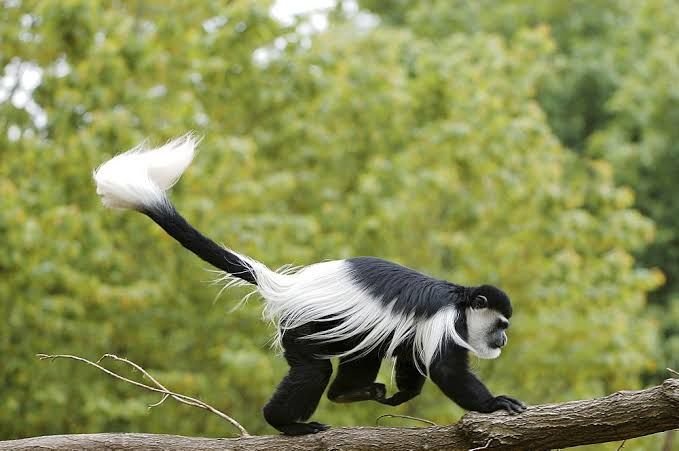
The black-and-white colobus monkey (Colobus guereza) is easily recognised by its black body, white facial markings and long white mantle of fur along its sides.
It is an arboreal primate, meaning it spends most of its time in trees. Its diet consists mainly of leaves, although it also eats flowers, fruits and other vegetation.
Black-and-white colobus monkeys occur in several Ugandan forests and woodland habitats. Visitors may encounter them in Kibale Forest, Bwindi and other suitable forest areas.
Their long limbs and reduced thumbs help them move between branches, while their long tails provide balance as they travel through the canopy.
6. Blue Monkey
The blue monkey (Cercopithecus mitis) is a forest monkey with greyish or olive-coloured fur, a darker face and a subtle bluish appearance to parts of its coat.
Despite its name, it is not bright blue. Its colouring is generally subdued, helping it blend into the forest environment.
Blue monkeys are found in several forested parts of Uganda, including Kibale, Bwindi and Mgahinga. They feed on fruits, leaves, flowers, insects and other available food.
They usually live in social groups and spend much of their time in the forest canopy.
7. Red-Tailed Monkey
The red-tailed monkey (Cercopithecus ascanius) is a small, active forest monkey recognised by its reddish tail, white markings around the nose and cheeks, and expressive face.
It occurs in several Ugandan forest habitats, including Kibale and other parts of western Uganda.
Red-tailed monkeys feed on fruits, seeds, leaves, flowers and insects. They are agile climbers and often travel through the middle and upper layers of the forest.
Visitors on guided forest walks may hear their calls before spotting them among the branches.
8. L’Hoest’s Monkey
L’Hoest’s monkey (Cercopithecus lhoesti) is a distinctive forest primate with dark fur, a pale beard and a characteristic white chest marking.
Unlike many monkeys that spend most of their time high in the trees, L’Hoest’s monkeys frequently forage on the forest floor and in lower vegetation. They feed on fruits, leaves, seeds and small invertebrates.
In Uganda, they occur in forest habitats including Bwindi, Kibale, Mgahinga and parts of Queen Elizabeth National Park’s forest environment.
Their shy behaviour can make them difficult to observe, but patient visitors may encounter them during guided walks.
9. Grey-Cheeked Mangabey
The grey-cheeked mangabey (Lophocebus albigena) is a forest monkey recognised by its dark coat, greyish cheeks and relatively long tail.
It is generally found in mature forests and spends much of its time moving through the canopy. Its diet includes fruits, seeds, leaves and other plant material.
Kibale Forest National Park is one of the important places to encounter grey-cheeked mangabeys in Uganda. They are often heard making loud calls as they move through the forest.
10. Olive Baboon
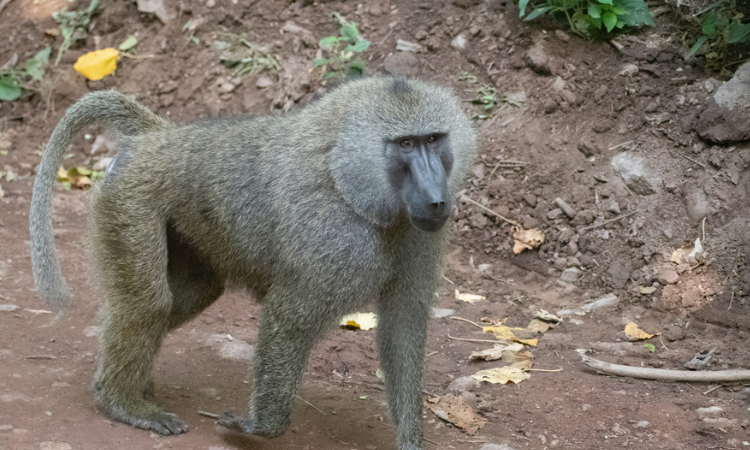
The olive baboon (Papio anubis) is one of Uganda’s most widely distributed primates. It is a large, ground-dwelling monkey with olive-brown fur, a long muzzle and a strong social structure.
Olive baboons live in troops containing males, females and young individuals. They spend much of their time on the ground searching for food, although they also climb trees to rest and avoid danger.
Their diet is varied and includes fruits, roots, seeds, insects and other available food.
They can be encountered in several Ugandan protected areas, including savannah and forest-edge habitats. Visitors may see them along roads, near park boundaries and during game drives.
11. Vervet Monkey
The vervet monkey (Chlorocebus pygerythrus) is a familiar primate in Uganda, recognised by its greyish coat, black face and white fringe of fur.
Vervet monkeys are adaptable and occupy a range of habitats, including woodland, savannah, forest edges and areas near human settlements.
They feed on fruits, leaves, seeds, flowers and insects. Their social groups have established hierarchies, and they use different alarm calls to communicate about potential threats.
Visitors may encounter vervet monkeys in several national parks and around some safari lodges.
12. Patas Monkey
The patas monkey (Erythrocebus patas) is a long-limbed primate adapted to open grassland and savannah environments.
It is known for its ability to run quickly across open ground, making it one of the fastest primates. Its reddish coat, pale underside and long limbs distinguish it from many forest monkeys.
In Uganda, patas monkeys are associated particularly with drier savannah and woodland habitats, including areas in the north and northeast.
They feed on seeds, fruits, insects and other small food items. Unlike many forest monkeys, they spend considerable time on the ground.
13. De Brazza’s Monkey
De Brazza’s monkey (Cercopithecus neglectus) is a distinctive forest primate recognised by its white beard, orange forehead marking and grey-brown coat.
It is generally shy and can be difficult to observe because it often remains still among dense vegetation when disturbed.
Its diet includes fruits, leaves, seeds and small animals. It occurs in suitable forest and riverine habitats in parts of Uganda, although sightings are not as frequent as those of some more widespread monkeys.
14. Potto
The potto (Perodicticus potto) is a slow-moving, nocturnal primate found in African tropical forests. It has dense brown fur, large forward-facing eyes and strong grasping hands and feet.
Unlike monkeys that are active during the day, pottos usually spend the night searching for food among branches. Their diet includes fruits, insects, tree gum and other small food items.
Pottos are difficult to see because they are nocturnal and move slowly through dense vegetation. A guided night walk in suitable forest habitat may provide an opportunity to encounter one.
15. Bushbabies (Galagos)
Bushbabies, also known as galagos, are small nocturnal primates found in several Ugandan woodland and forest habitats.
They are recognised by their large eyes, strong hind legs, long tails and remarkable jumping ability. These adaptations help them move quickly between branches while searching for food.
Bushbabies feed on insects, fruits, tree gum and other small food sources, depending on the species.
Several galago species have been recorded in Uganda, including dwarf galagos and other lesser galagos. Their calls can often be heard at night, even when the animals themselves are difficult to locate.
Where to See Primates in Uganda
Uganda’s primates are distributed across several national parks, forests and wildlife reserves. The best destination depends on which species you want to see and whether you prefer guided tracking, general wildlife viewing or nocturnal forest walks.
Kibale Forest National Park
Kibale Forest National Park is one of Uganda’s leading primate destinations. Its tropical forest supports a rich variety of primates, including chimpanzees, red colobus monkeys, black-and-white colobus monkeys, blue monkeys, red-tailed monkeys, L’Hoest’s monkeys, olive baboons and grey-cheeked mangabeys.
The park is especially famous for chimpanzee tracking and chimpanzee habituation experiences. Visitors can also explore Bigodi Wetland Sanctuary, where guided community walks provide opportunities to see monkeys and a variety of bird species.
Bwindi Impenetrable National Park
Bwindi is internationally recognised for mountain gorilla trekking. In addition to gorillas, its forests support several monkey species, including L’Hoest’s monkeys, black-and-white colobus monkeys, red-tailed monkeys and blue monkeys.
The park’s dense vegetation and mountainous terrain make it an important habitat for forest wildlife. Guided gorilla trekking and other permitted forest experiences provide opportunities to appreciate its biodiversity.
Mgahinga Gorilla National Park
Mgahinga Gorilla National Park is part of the Virunga conservation landscape and protects mountain gorillas, golden monkeys and other forest wildlife.
Golden monkey tracking is one of its signature activities. Visitors can also arrange mountain gorilla trekking and explore the park’s bamboo forests and volcanic slopes.
Queen Elizabeth National Park
Queen Elizabeth National Park is mainly known for savannah wildlife, including elephants, lions, buffaloes, hippos and numerous antelope species. However, its forest habitats also support primates.
Kyambura Gorge is particularly known for chimpanzee tracking. Other primates, including baboons and monkeys, may be encountered in suitable habitats across the wider conservation area.
Budongo Forest
Budongo Forest, within the Murchison Falls conservation landscape, is an important habitat for chimpanzees and other forest primates.
Guided chimpanzee tracking provides an opportunity to observe chimpanzees in their natural environment. The forest is also home to several monkey species and diverse birdlife.
Kalinzu Forest
Kalinzu Forest is another destination for chimpanzee tracking in western Uganda. It offers guided forest experiences and opportunities to encounter other primates, including monkeys living in the forest canopy.
Semliki National Park
Semliki National Park protects lowland tropical forest habitats in western Uganda. Its primate diversity includes chimpanzees and several monkey species, alongside other forest mammals and birds.
The park is particularly interesting for travellers who want to explore a different forest ecosystem from the montane forests of Bwindi and Mgahinga.
Best Time to See Primates in Uganda
Uganda is a year-round primate destination because its forests support resident primate populations throughout the year. However, weather conditions can influence trekking comfort, forest trails and road access.
The relatively drier periods are generally:
- June to September: Often favourable for gorilla trekking, chimpanzee tracking and other forest walks.
- December to February: Another generally drier period, suitable for combining primate experiences with wildlife safaris.
The wetter periods, usually March to May and October to November, can also be rewarding. Forests become lush, and some visitors prefer travelling when there are fewer tourists. However, trails may become muddy and slippery.
The best time for your trip depends on your preferred activities, travel dates and tolerance for wet forest conditions. Gorilla and chimpanzee tracking should always be arranged around confirmed permit availability.
How to Plan a Uganda Primate Safari
A Uganda primate safari can focus on one species or combine several experiences across different forests and national parks.
For example:
- Gorilla trekking: Visit Bwindi Impenetrable National Park or Mgahinga Gorilla National Park.
- Chimpanzee tracking: Visit Kibale Forest, Budongo Forest or Kyambura Gorge.
- Golden monkey tracking: Visit Mgahinga Gorilla National Park.
- Forest monkey watching: Explore Kibale, Bwindi, Mgahinga and other suitable forest habitats.
- Nocturnal primate watching: Arrange a guided night walk in a suitable location where the activity is permitted.
A longer itinerary can combine chimpanzee tracking in Kibale, wildlife viewing in Queen Elizabeth National Park and mountain gorilla trekking in Bwindi. The best route depends on your available time, accommodation preferences and transport arrangements.
Explore our Uganda safari packages or contact Gorilla Nests Safaris for a tailor-made primate itinerary.
Why Are Primates Important to Uganda’s Ecosystems?
Primates play several important roles in Uganda’s forests and natural environments.
Seed dispersal: Many monkeys and apes eat fruits and distribute seeds across the forest through their movement and droppings. This supports natural forest regeneration.
Forest biodiversity: Primates form part of complex food webs and contribute to the ecological balance of their habitats.
Ecotourism and livelihoods: Gorilla trekking, chimpanzee tracking and other primate experiences attract visitors and create employment for guides, trackers, rangers, lodge workers and surrounding communities.
Scientific research: Studying primates helps researchers understand animal behaviour, social relationships, evolution, disease ecology and forest conservation.
Protecting primates therefore also means protecting the forests and wider ecosystems on which many other species depend.
Threats Facing Primates in Uganda
Despite Uganda’s protected areas and conservation initiatives, primates face several threats.
- Habitat loss: Agricultural expansion, settlement and infrastructure development can reduce and fragment forest habitats.
- Illegal hunting and trapping: Some primates are threatened by hunting and accidental capture in snares.
- Human-wildlife conflict: Animals may enter farms or settlements when natural habitats become fragmented.
- Disease transmission: Some infectious diseases can pass between humans and great apes, making responsible visitor behaviour essential.
- Climate and environmental change: Changes in rainfall, temperature and vegetation can affect food availability and habitat conditions.
Conservation measures include protected-area management, law enforcement, habitat restoration, research, community engagement and responsible tourism.
Visitors can support conservation by following park rules, maintaining the required distance from wildlife, avoiding littering and choosing responsible tourism operators.
FAQs About the Primates of Uganda
How many primate species are found in Uganda?
Uganda is commonly described in tourism references as having around 20 primate species. However, published totals vary depending on the taxonomy and classification used. Its primates include great apes, monkeys, galagos and pottos.
What are the most famous primates in Uganda?
The most famous primates in Uganda are mountain gorillas, chimpanzees and golden monkeys. They attract visitors to Bwindi Impenetrable National Park, Mgahinga Gorilla National Park and Kibale Forest National Park.
Which national park in Uganda has the most primates?
Kibale Forest National Park is particularly well known for its high primate diversity. It supports chimpanzees and numerous monkey species, making it one of the country’s leading destinations for primate watching.
Can I see gorillas and chimpanzees on the same Uganda safari?
Yes. You can combine mountain gorilla trekking in Bwindi or Mgahinga with chimpanzee tracking in Kibale Forest. A multi-day itinerary allows time for transfers between the parks and the two separate tracking experiences.
Where can I see golden monkeys in Uganda?
Golden monkeys can be tracked in Mgahinga Gorilla National Park in southwestern Uganda. The experience takes visitors into bamboo forest habitat to observe habituated groups.
Are there monkeys in Queen Elizabeth National Park?
Yes. Queen Elizabeth National Park and its associated forest habitats support several primate species. Visitors may encounter olive baboons, red-tailed monkeys and other monkeys, while Kyambura Gorge is known for chimpanzee tracking.
Are bushbabies found in Uganda?
Yes. Bushbabies, or galagos, are nocturnal primates found in Uganda’s forest and woodland habitats. Their large eyes and powerful hind legs help them move through trees at night.
Are pottos found in Uganda?
Yes. Pottos are nocturnal primates that inhabit tropical forests. They are difficult to observe because they are active at night and move slowly through dense vegetation.
What is the difference between a monkey and an ape?
Apes, such as gorillas and chimpanzees, do not have external tails. Monkeys generally have tails, although their size and function vary between species. Apes also differ from monkeys in several aspects of anatomy, movement and social behaviour.
Are Uganda’s primates endangered?
Some Ugandan primates are threatened, including mountain gorillas, eastern chimpanzees, golden monkeys and Uganda red colobus monkeys. Their conservation status differs by species and should be checked against current assessments.
Can I see primates without going gorilla trekking?
Yes. You can see several primate species without purchasing a gorilla trekking permit. Chimpanzee tracking, golden monkey tracking, guided forest walks and other wildlife excursions offer alternative experiences. Some monkeys may also be seen during ordinary park visits and game drives.
What is the best primate safari in Uganda?
The best itinerary depends on your interests. A trip combining Kibale Forest for chimpanzees, Queen Elizabeth National Park for wildlife and Bwindi for mountain gorillas offers a varied primate and wildlife experience. Travellers with less time can focus on one destination.
Explore the Primates of Uganda with Gorilla Nests Safaris
Uganda’s primates make the country an exceptional destination for wildlife enthusiasts. From mountain gorillas in Bwindi and Mgahinga to chimpanzees in Kibale, golden monkeys in the Virunga forests and colourful monkeys throughout the country’s forests, each encounter reveals a different part of Uganda’s natural heritage.
Gorilla Nests Safaris organises Uganda primate safaris, gorilla trekking trips, chimpanzee tracking experiences and wider wildlife adventures. Whether you want a short primate excursion or a longer safari combining several national parks, our team can help plan an itinerary around your travel dates, interests and budget.
Contact Gorilla Nests Safaris to plan your Uganda primate safari and discover the country’s remarkable great apes, monkeys and nocturnal primates.