

Kakamega Forest: Photos, Entry Fee, Animals, Location & more
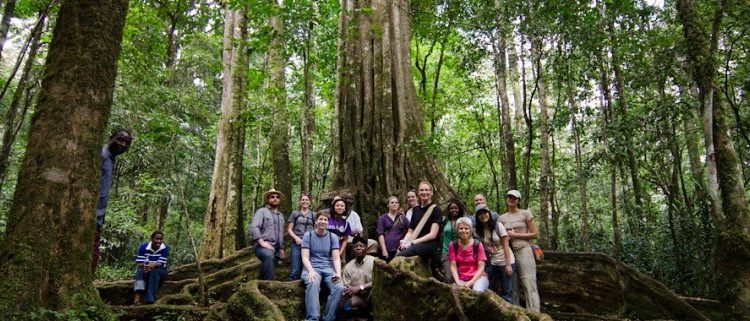
Kakamega Forest is a captivating tropical rainforest nestled in western Kenya, renowned as the country’s only remaining fragment of the ancient Guineo-Congolian rainforest that once stretched across Africa.
This lush ecosystem, often called Kakamega Forest National Reserve, offers an unparalleled blend of biodiversity, eco-tourism opportunities, and cultural experiences.
Located in Kakamega County, it’s a haven for nature enthusiasts seeking Kakamega Forest activities like birdwatching and guided hikes.
As Kenya’s last tropical rainforest, it stands out for its dense canopy, vibrant wildlife, and role in conservation, making it a must-visit for those exploring Kakamega Forest Kenya.
Whether you’re drawn to the thrill of spotting rare birds or the serenity of eco-tourism trails, Kakamega Forest provides an immersive escape into nature.
Its uniqueness lies in its West African affinities, with species not found elsewhere in Kenya, emphasizing its value as a biodiversity hotspot.
Location & Geography of Kakamega Forest
Kakamega Forest location places it in the heart of western Kenya, spanning Kakamega, Vihiga, and Nandi counties. Situated northwest of Nairobi, it’s approximately 400 kilometers from the capital, making it accessible via a scenic drive or a short flight to Kisumu Airport, followed by a 50-kilometer road trip north.
The forest lies near the border with Uganda, within the Lake Victoria catchment basin, and just west of the Nandi Escarpment.
Geographically, Kakamega Forest size covers about 238 square kilometers, with roughly half remaining as indigenous forest. It sits at an elevation of 1,500 to 1,600 meters above sea level, contributing to its mild, wet climate.
This tropical rainforest in Kenya is an eastern outlier of the vast Congo Basin rainforest, connected historically through ancient forest corridors.
Rivers like the Isiukhu and Yala flow through it, gathering tributaries and underscoring its role as a vital water catchment.
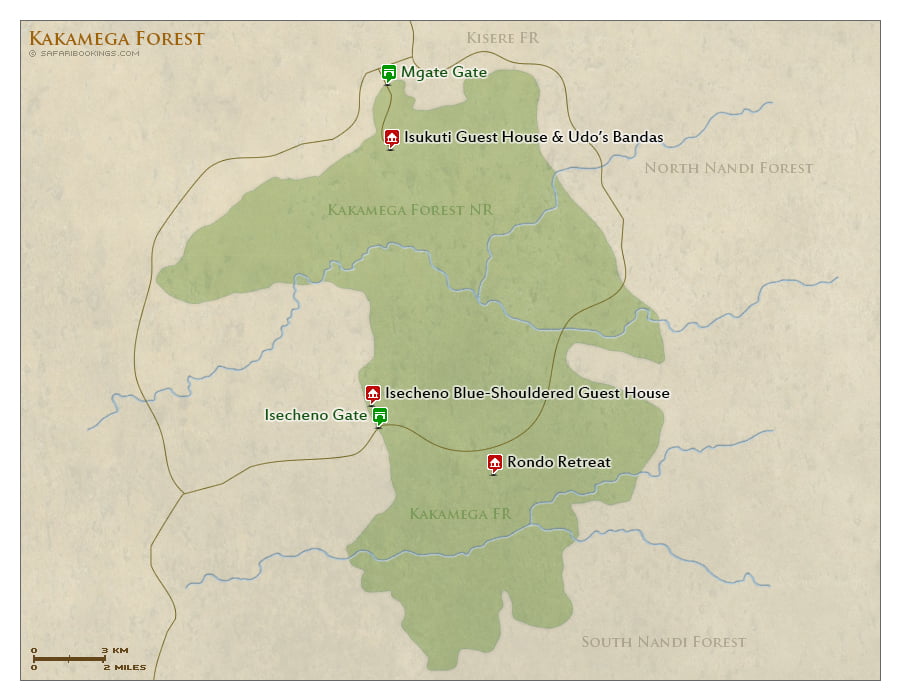
For visitors, the Kakamega Forest map reveals key entry points: the northern section, managed by Kenya Wildlife Service (KWS) as Kakamega Forest National Reserve (44.7 km²), and southern areas under Kenya Forest Service (KFS).
The terrain features rolling hills, dense undergrowth, and towering trees, ideal for eco-tourism adventures. Distances from major towns include about 50 km from Kisumu and 100 km from Eldoret, with well-maintained roads facilitating access.
The climate is humid, with annual rainfall peaking in April-May and August-September, but drier periods in January-February offer comfortable exploration. This geography not only supports rich flora but also positions Kakamega Forest as a bridge between East and West African ecosystems.
Biodiversity & Wildlife in Kakamega Forest
Kakamega Forest wildlife is a cornerstone of its appeal, boasting an extraordinary array of species that highlight its biodiversity value. As a remnant of the Guineo-Congolian rainforest, it harbors over 300 bird species, more than 400 butterfly varieties, and seven primate species, making it a prime spot for eco-tourism and birdwatching.
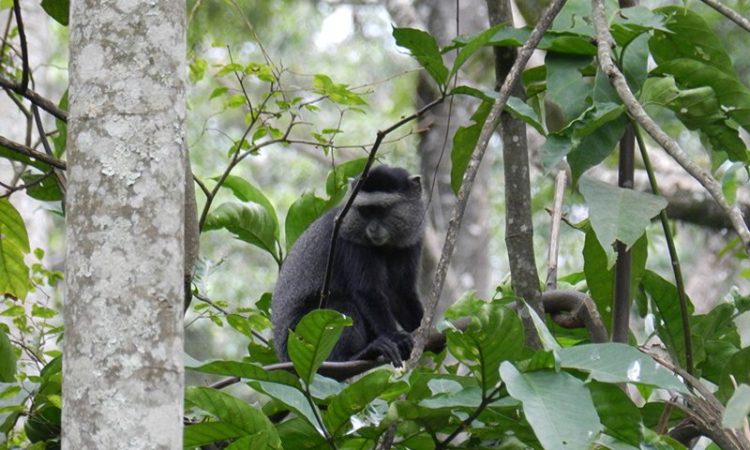
Among the mammals, primates steal the show. Blue monkeys, red-tailed monkeys, and the elusive De Brazza’s monkey swing through the canopy, often spotted during guided walks.
Other Kakamega Forest animals include olive baboons, black-and-white colobus monkeys, potto, giant otter shrew, and Lord Derby’s anomalure—many with West African origins. Small mammals like forest squirrels and civets add to the diversity.
Birds of Kakamega Forest are a major draw for birdwatching enthusiasts. Iconic species include the great blue turaco, blue-headed bee-eater, grey parrot, black-billed turaco, and Ross’s turaco.
With over 400 species recorded, it’s a birdwatcher’s paradise, featuring endemics and migrants. Eco-tourism here often involves dawn birding sessions to catch the chorus of calls from species like the Hartlaub’s turaco and square-tailed drongo.
Insects and plants thrive too. Over 400 butterfly species flutter among indigenous trees like Elgon teak and African satinwood, many with medicinal properties used by local communities. The forest floor and understory host vibrant orchids, ferns, and strangler figs, some over 700 years old.
Kakamega Forest snakes add an element of intrigue, with 36 unique species, many from West Africa. Venomous ones include the forest cobra, black-lipped cobra, Jameson’s mamba, bush viper, rhinoceros-horned viper, Gaboon viper, and Goldie’s tree cobra (endemic and endangered).
Non-venomous species like barred green snakes and prickly bush vipers are also present. Encounters are rare, but guides ensure safe eco-tourism experiences.
This biodiversity underscores Kakamega Forest’s role in global conservation, supporting eco-tourism that educates and protects.
Things to Do in Kakamega Forest
Kakamega Forest activities cater to eco-tourism lovers, with a focus on immersive, sustainable experiences. Birdwatching tops the list, optimized for spotting rarities like the great blue turaco during guided dawn walks. Specialized tours delve into the forest’s 300+ bird species, making it ideal for photographers and enthusiasts.
Guided nature walks and forest hikes explore trails like those to Isiukhu Falls or the ancient fig tree, revealing Kakamega Forest nature walks through dense canopies and river crossings. These eco-tourism staples last 2-4 hours, highlighting medicinal plants and primate sightings.
Butterfly watching is another highlight, with over 400 species creating colorful spectacles. Cultural village visits to nearby Luhya communities offer insights into traditional uses of the forest, blending eco-tourism with heritage.
For adventure, try canopy walks (where available) or cycling on designated paths. Night walks reveal nocturnal wildlife like potto and owls, enhancing the eco-tourism appeal. Picnicking and scenic viewing at viewpoints provide relaxed options.
All activities emphasize sustainability, with KWS and local guides promoting low-impact eco-tourism to preserve this rainforest gem.
Accommodation & Lodges Near Kakamega Forest
Lodges near Kakamega Forest blend comfort with nature immersion. Rondo Retreat Centre offers serene self-catering chalets amid gardens, ideal for birdwatching retreats. Golf Hotel Kakamega, just outside the forest, provides modern rooms with pools and gardens.
For eco-friendly stays, Isecheno KEEP Bandas and Forest Rest House offer basic yet charming accommodations inside the reserve. Kakamega Forest camping is popular at sites like Isecheno Camping and Udo’s Bandas, where tents under the canopy allow for stargazing and wildlife sounds.
Nearby hotels in Kakamega town, like Prinias Hotel or Ciala Resort (near Kisumu), provide upscale options with amenities. Accommodation in Kakamega ranges from budget campsites (KSH 500/night) to luxury lodges ($100+).
Kakamega Forest Entry Fee & Opening Hours
Kakamega Forest entry fee varies by category for 2026. Non-residents pay USD 22-50 per adult and USD 13-25 per child (under 18) for a 24-hour pass. East African citizens and residents: KSH 300-500 adult, KSH 125-200 child. Vehicle fees: KSH 600 for <6 seats, up to KSH 5,000 for larger buses. Guided tours add KSH 1,000-2,000.
Kakamega Forest opening hours are 8 AM to 6 PM daily, year-round, including holidays. Early arrivals for sunrise birdwatching or night walks can be arranged with advance booking.
Payments are cashless via M-Pesa or cards at gates. Fees support conservation, ensuring sustainable eco-tourism.
Best Time to Visit Kakamega Forest
The best time to visit Kakamega Forest aligns with dry seasons for optimal trails and wildlife viewing: June to August and December to February. These months offer Kakamega Forest weather with less rain (driest in January-February), mild temperatures (20-25°C), and firm paths for hikes.
For birdwatching, June-August is prime, with clear skies and active species. Eco-tourism thrives then, as butterflies and flowers peak post-rains. Avoid April-May and November for heavy rains, which make trails muddy.
Rainy seasons (April-July, August-September) bring lush greenery but slippery conditions. Year-round visitation is possible, but dry periods enhance experiences.
Kakamega Forest Conservation & History
The history of Kakamega Forest dates to its gazetting as a Trust Forest in 1933, protecting it from exploitation. In 1967, Yala and Isecheno Nature Reserves were established, followed by the northern section becoming Kakamega Forest National Reserve in 1985, amalgamating with Kisere Forest. This marked a shift toward formal conservation amid threats like deforestation for timber and agriculture.
Kakamega Forest conservation efforts address ongoing challenges, including illegal logging and encroachment. Initiatives by KWS, KFS, and organizations like Rhino Ark include a 117-km fence to curb poaching and protect biodiversity. Community involvement is key, with locals participating in eco-tourism and reforestation.
The forest’s importance lies in carbon sequestration, water catchment, and preserving endemic species. UNESCO recognizes it as a tentative World Heritage site for its unique ecology. Conservation builds trust, ensuring this ancient rainforest endures.